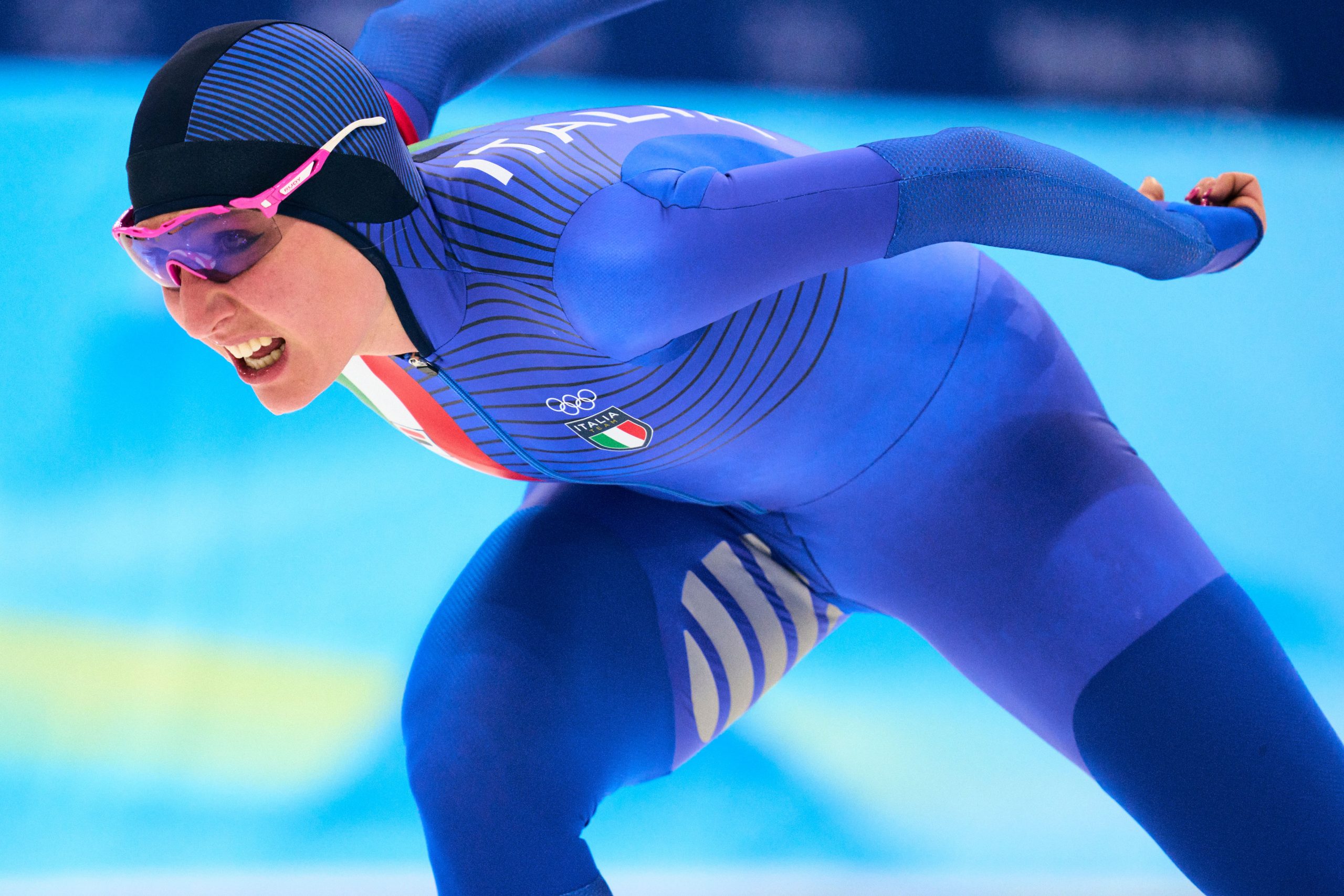


Press conference presentation of the results of the study “Gender equality and representation in the media: From Paris 2024 to Milan Cortina 2026”
On Thursday 19 March 2026, a press conference was held at the Lombardy Region Press Room to present a research paper on the media coverage of sporting events seen from a gender perspective. The study was promoted by the Bracco Foundation and the International Olympic Committee in collaboration with the Milano Cortina 2026 Foundation.
Designed to monitor coverage over an arc of time, the study was conducted by Osservatorio di Pavia, a media research institute. It looked at how the main television news programmes broadcast between July 2024 and March 2026 covered male and female sporting events. It divided the coverage into three phases: 1) the Paris Games 2024; 2) a year of ordinary news reporting; 3) the Milan-Cortina 2026 Winter Olympics.
The analysis -- the first nationwide study on this subject -- reveals a complex picture.
During the Paris 2024 Olympic Games, the media narratives came out as balanced, with female athletes featuring in 49% of news reports (compared to 51% for men). Even so, stereotyping, which was detected in 7% of the coverage, was directed against women in 73% of the cases. The study also found that women are still rarely consulted as experts, and made up just 26% of the pool of contributors and commentators. The Paralympic Games, however, saw less coverage, and a greater bias in favour of men.
At the Milano Cortina 2026 Olympic Games, the visibility of female athletes improved significantly with respect to past events, with women featuring in 58% of the reporting, thanks also to their success in winning important medals. The improved representation was not, however, accompanied by a more evolved narrative, with 16% of the content still perpetuating stereotypes, 81% of them to the detriment of women. The number of female experts employed as commentators or opinion leaders grew to 31% of the total. In line with the findings from Paris, the Paralympic Games continue to receive extremely limited coverage (25 news items compared to 331 for the Olympics). Within this scope, female para-athletes remain largely invisible, and the narrative continues to be dominated by male authorities who account for 86% of the discourse.
The period of ordinary coverage in the interval between the two events was marked by a notable imbalance. Only 13% of the coverage was devoted to women’s sport, compared with 75% to men’s sport, and 40% of it focused on football (of which only 2% is dedicated to women).
In short, the visibility of women participants of major sporting events has improved, but continues to struggle to become a consolidated praxis, and is sometimes accompanied by narratives that diminish the value of women’s sporting achievements. The challenge now is to transform these gains into lasting change by ensuring that female representation becomes a stable and systematised feature that no longer relies on a purely event-driven approach.
The press conference, moderated by Valeria Ciardiello (sports journalist and TV presenter), heard from institutional representatives and experts in the sector. Attilio Fontana, President of the Lombardy Region, reaffirmed the event’s strategic importance for the region and noted the pre-eminent role of women athletes at the Milano Cortina Games. Federica Picchi, Undersecretary for Sport and Youth in the government of the Region of Lombardy, opened the proceedings by highlighting the milestones reached in female participation and the ongoing commitment to supporting women athletes. Elena Lattuada, Delegate for Gender Equality representing the Mayor of Milan, drew attention to the need for consistent visibility for women's sports beyond major international events. Diana Bracco, Chair of the Bracco Foundation, highlighted the exceptional talent of the Italian women athletes who made such an impression at the Games, but noted that the extraordinary achievements of Paralympic athletes of both sexes remain significantly under-recognised by the media.
The next speaker, Monia Azzalini, Head of Diversity, Equity and inclusion at Osservatorio di Pavia, presented the main research results. Charlotte Groppo, Head of Gender Equality, Diversity and Inclusion at the International Olympic Committee, drew attention to the progress made by the International Olympic Committee on gender equality, and urged the media to continue along this path to keep up with developments already taking place in society. Other speakers included Andrea Monti, Chief Communications Officer of the Milano Cortina 2026 Foundation, Greta Barbone, Human Rights Manager of the Milano Cortina 2026 Foundation, and Valentina Marchei, Olympic athlete, Head of the Ambassador Programme for the Milano Cortina 2026 Foundation, and Chair of the Board of Athletes of the Italian Olympic Committee (CONI). From their respective perspectives, they provided in-depth insights into the Milano Cortina 2026 Foundation’s work in the areas of communication, rights, and athlete engagement.
The study presented at today's press conference constitutes a knowledge base that is not so much an end in itself as a starting point for from which the media can begin its journey towards increasingly informed and responsible sports communication.
The media coverage of the Olympics and Paralympics Games examined from a gender perspective
The study of the media coverage of the Olympics and Paralympics Games carried out by Osservatorio di Pavia has been promoted by the International Olympic Committee and the Bracco Foundation with the purpose of garnering evidence useful for guiding the policy-making and actions of private and public institutions.
Read more